Traveling to Japan in Summer: July, August and the Festivals Nobody Mentions
The most common warning about Japan in summer is that the heat is brutal. The warning is correct. What it leaves out is everything else: the densest festival calendar of the year, mountains at 18°C three hours from Tokyo, and an entire country engineered to run at 33 degrees.
Because yes, Tokyo in July averages a high of 33°C (91°F) with humidity above 80%. A sauna with vending machines (about 4 million of them nationwide, one for every 31 people, so you're never more than a block from a cold drink). But Japan is built for this, and once you stop fighting the climate and start traveling with it, summer stops being an obstacle.
Advertising
Plan your day around the heat, not against it
The locals have this figured out. Mornings are for sightseeing: temples at 7am are empty, cool, and genuinely magical. Midday is for being indoors: museums, long lunches, the deliciously over-air-conditioned department store basements. Evenings are when the country comes alive again, and that's when summer earns its reputation.
The 6 a.m. konbini coffee ritual
What the locals do at 6 a.m.: walk to the corner konbini (there are 56,000+ of them, open around the clock), buy a canned iced coffee for about 130 yen (roughly €0.80), and drink it outside while the city is still quiet. It's the coolest hour of the day and the only one when Shibuya feels like a village. It works just as well with jet lag as without it.
Summer in Japan isn't a season you endure. It's a festival you get invited to, every single night.
Advertising
The festivals are the whole point
This is what the warnings miss completely: July and August hold the best matsuri of the year. Not "festive atmosphere" in the abstract. Actual dates:
- Gion Matsuri (Kyoto): runs the entire month of July, with the Yamaboko Junko float processions on July 17 and 24. Multi-ton wooden floats hauled by hand through the city center.
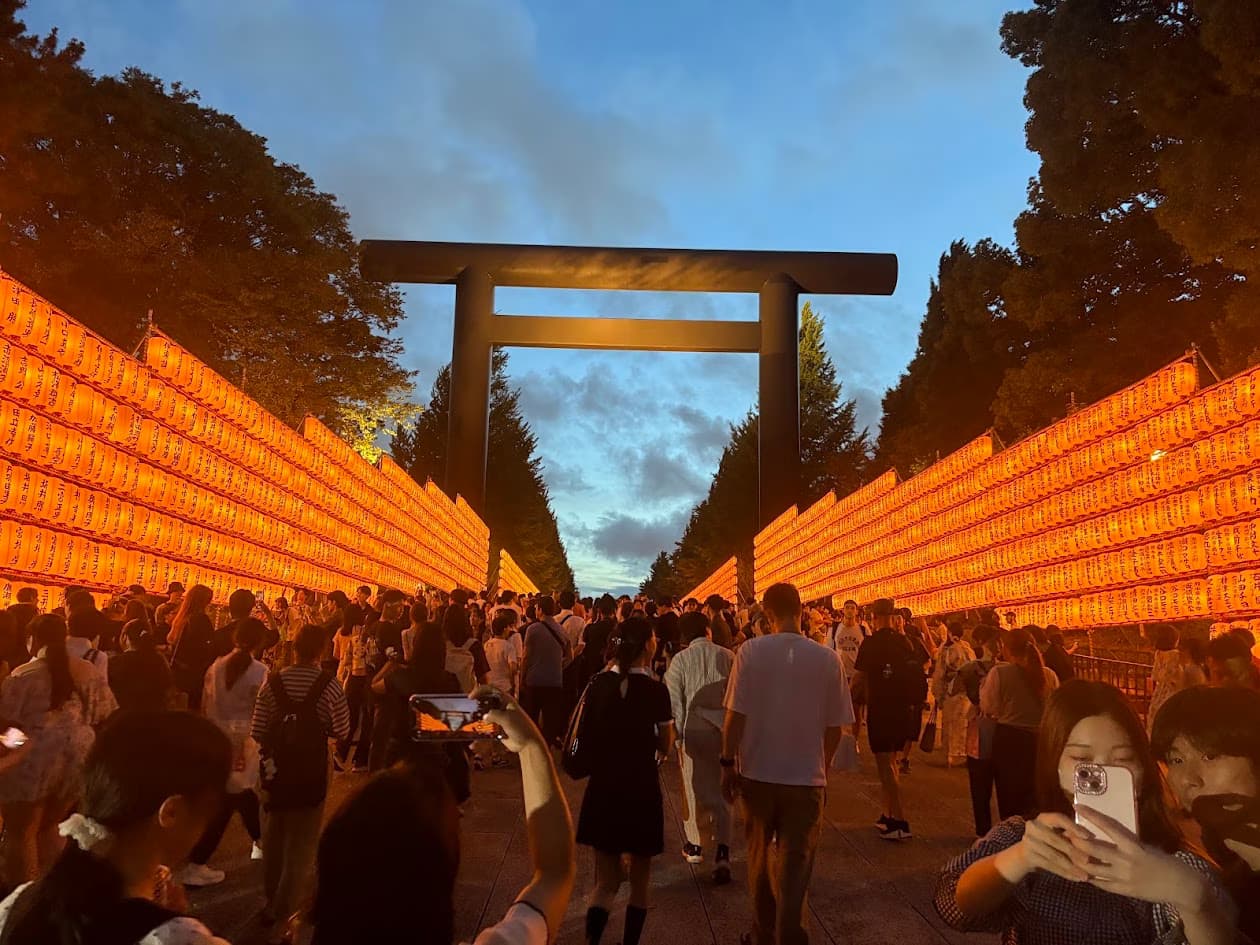
- Mitama Matsuri (Tokyo, Yasukuni Shrine): July 13-16. Around 30,000 paper lanterns hung throughout the shrine grounds, with traditional dances and bon-odori after dark. One of the few spots in central Tokyo that feels completely different at night.
- Tenjin Matsuri (Osaka): July 24-25. One of Japan's three great festivals, with a boat procession on the river and fireworks on the second night.
- Sumida River Fireworks (Tokyo): usually the last Saturday of July. Less a "display" and more "the entire city sits on a riverbank together."
- Nebuta Matsuri (Aomori): August 2-7. Giant illuminated floats paraded at night. Arguably the most spectacular of them all, and the one that justifies going up to northern Honshu.
- Kanto Festival (Akita): August 3-6. Performers balance bamboo poles up to 12 meters tall, each holding 46 lit paper lanterns, shifting the load between forehead, chin, shoulder and palm. The crowd watches in near-silence. Harder to describe than to watch.
- Hanagasa Matsuri (Yamagata): August 5-7. Over 10,000 dancers parade in summer happi coats wearing enormous straw hats covered in safflower blossoms. The flower-hat choreography is specific to Yamagata and looks like nothing else in Japan.
- Tanabata Matsuri (Sendai): August 6-8. The Sendai version is the largest in the country: entire shopping streets canopied in over 3,000 paper streamers hanging from bamboo poles, based on the legend of two stars meeting once a year across the Milky Way.
- Yosakoi Matsuri (Kochi): August 9-12. The original Yosakoi festival, before the style spread across Japan. Teams of 10 to 150 dancers with wooden naruko clappers, mixing traditional moves with choreography rehearsed for months.
- Awa Odori (Tokushima, Shikoku): August 12-15. Street dancing at the scale of a whole city, overlapping with Obon (August 13-16), when Obon Odori dances repeat in neighborhoods across the country.
- Yamaga Toro (Kumamoto): August 15-16. A thousand women in yukata dance through the streets with gold washi-paper lanterns balanced on their heads, not held. The silhouette at night doesn't look like any other festival in Japan.
Typical annual dates. Sumida River Fireworks and Tanabata Matsuri exact dates vary by year, confirm before booking.
Advertising
Nothing about autumn's pretty leaves competes with that feeling. You look at autumn; you dance in summer.
Escape to the mountains when the cities get heavy
Here's the cheat code: when Tokyo or Kyoto gets oppressive, Japan has an entire vertical country waiting. The numbers matter here. Tokyo in July: highs of 33°C (91°F). Sapporo, up in Hokkaido: 26°C (79°F). Kamikochi, in the Japanese Alps: 18-22°C (64-72°F), light-jacket weather after dark. That 10-15 degree gap is one train or one domestic flight away. Put two or three mountain nights in the middle of the trip and the city heat goes from problem to anecdote.
What to actually pack
A few things you'd normally pack are cheaper and better at any konbini. Leave them at home.
- A small towel. Everyone carries one. You'll understand by day two.
- Breathable everything: linen and technical fabrics over cotton, which stays damp.
- Sunscreen: Don't pack a bottle. Japanese konbinis and pharmacies carry lighter, sweat-resistant formulas for under 1,000 yen. The one from home just takes up space.
- Mosquito repellent: Evening festivals are outdoors and the mosquitoes know it. Skin Vape at any konbini is 500-800 yen. Japanese versions include a moisturizer, which at 80% humidity is actually welcome.
- Cooling spray: Small aerosol cans next to every konbini checkout. Spray on your neck, arms, face. Non-negotiable between 12pm and 4pm. No point packing one from home.
- Umbrella: July is the tail end of Japan's rainy season and afternoon downpours can soak you in minutes. Every konbini sells disposable umbrellas for 500-700 yen. Don't bring one. (You'll leave it at a restaurant anyway.)
- One slightly nicer outfit for an evening festival, because you'll want to be in the photos. Or skip it entirely and rent a yukata there: it's the lightweight cotton summer kimono everyone wears to matsuri. Rental stalls near any tourist area charge 2,000-4,000 yen, hair styling included if you want it.
If mild weather is what you're after, go in November. But if you want the Japan that dances in the street, the one with fireworks over the river and empty temples at 7 a.m., that one only exists in July and August.
Time your Japan summer right.
Planisky reads the weather, the festival calendar and the fares together, so you land in the cool weeks and catch the good nights. Free month for the first 100.